Sunday Sermon: Malice Of Mortal Sin
Written by AJ Baalman on January 4, 2026
Support Our Immediate Need For Equipment
Keep Supporting Our Server Upgrade
” Behold, thy father and I have sought thee sorrowing. 1 LUKE ii. 48.
MOST holy Mary lost her Son for three days: during that time she wept continually for
having lost sight of Jesus, and did not cease to seek after him till she found him.
grace; and instead of weeping for so great a loss, sleep in peace, and make no effort to recover
so great a blessing? This arises from their not feeling what it is to lose God by sin. Some say: I
commit this sin, not to lose God, but to enjoy this pleasure, to possess the property of
another, or to take revenge of an enemy. They who speak such language show that they do
not understand the malice of mortal sin.
Second Point. It is a great offence offered to God.
mortal sin, after they had been created by him, nourished with his blood, and exalted to the
dignity of his adopted children. ”Hear, O ye Heavens, and give ear, Earth; for the Lord hath
spoken. I have brought up children _ and exalted them; but they have despised me.” (Isa. i. 2.)
Who is this God whom sinners despise?; He is a God of infinite majesty, before whom all the
kings of the Earth and all the blessed in Heaven are less than a drop of water or a grain of
sand. As a drop of a bucket, . . . as a little dust. ” (Isa. xl. 15.) In a word, such is the majesty of
God, that in his presence all creatures are as if they did not exist. ”All nations are before him
as if they had no being at all.” (Ibid. xl. 17.) And what is man, who insults him? St. Bernard
answers: ”Saccus vermium, cibus vermium.” A heap of worms, the food of worms, by which
he shall be devoured in the grave. ”Thou art wretched and miserable, and poor, and blind,
and naked.” (Apoc. iii. 17.) He is so miserable that he can do nothing, so blind that he knows
nothing, and so poor that he possesses nothing. And this worm dares to despise a God, and
to provoke his wrath. ”Vile dust,” says the same saint, ”dares to irritate such tremendous
majesty.” Justly, then, has St. Thomas asserted, that the malice of mortal sin is, as it were,
infinite: ”Peccatum habet quandam infinitatem malitiae ex infinitatem divine majestatis.”
(Par. 3, q. 2, a. 2, ad. 2.) And St. Augustine calls it an infinite evil. Hence Hell and a thousand
Hells are not sufficient chastisement for a single mortal sin.
good.” St. Thom., par. 1, q. 24, a. 4; a turning ones back on the sovereign good. Of this God
complains by his prophet, saying: ”Thou hast forsaken me, saith the Lord; thou art gone
backward. ” (Jer. xv. 6.) Ungrateful man, he says to the sinner, I would never have separated
myself from thee; thou hast been the first to abandon me: thou art gone backwards; thou hast
turned thy back upon me.
law, he loses the divine grace. “By transgression of the law, thou dishonourest God.” (Rom.
ii. 23.) God is the Lord of all things, because he has created them. ”All things are in thy
power… Thou hast made Heaven and Earth.” (Esth. xiii. 9.) Hence all irrational creatures the
winds, the sea, the fire, and rain obey God, ”The winds and the sea obey him.” (Matt. viii.
27.)”Fire, hail, snow, ice, stormy winds, which fulfil his word.” (Ps. cxlviii. 8.) But man, when
he sins, says to God: Lord, thou dost command me, but I will not obey; thou dost command
me to pardon such an injury, but I will resent it; thou dost command me to give up the
property of others, but I will retain it; thou dost wish that I should abstain from such a
forbidden pleasure, but I will indulge in it.
the desert, the sinner answers: “Who is the Lord, that I should hear his voice, and let Israel
go ?” (Exod. v. 2.)
sinners offend him. ”Wherefore hath the wicked provoked God.” (Ps. x. 13.) For what do so
many offend the Lord? For a little vanity; for the indulgence of anger; or for a beastly
pleasure. ”They violate me among my people for a handful of barley and a piece of bread.”
(Ezec. xiii. 19.) God is insulted for a handful of barley for a morsel of bread! God! why do we
allow ourselves to be so easily deceived by the Devil?”There is,” says the Prophet Osee, “a
deceitful balance in his hand.” (xii. 7.) We do not weigh things in the balance of God, which
cannot deceive, but in the balance of Satan, who seeks only to deceive us, that he may bring
us with himself into Hell. ”Lord,” said David, ”who is like to thee ?” (Ps. xxxiv. 10.) God is an
infinite good; and when he sees sinners put him on a level with some earthly trifle, or with a
miserable gratification, he justly complains in the language of the prophet: ”To whom, have
you likened me or made me equal? saith the Holy One.” (Isa. xl. 25.) In your estimation, a vile
pleasure is more valuable than my grace. Is it a momentary satisfaction you have preferred
before me?”Thou hast cast me off behind thy back.” (Ezec. xxiii. 35.) Then, adds Salvian,
”there is no one for whom men have less esteem than for God.” (Lib. v., Avd. Avar.) Is the
Lord so contemptible in your eyes as to deserve to have the miserable things of the Earth
preferred before him?
to give them to the holy martyr if he would renounce the faith of Christ. The saint heaved a
sigh of sorrow at the sight of the blindness of men, who put earthly riches in comparison
with God. But many sinners exchange the divine grace for things of far less value; they seek
after certain miserable goods, and abandon that God who is an infinite good, and who alone
can make them happy. Of this the Lord complains, and calls on the Heavens to be astonished,
and on its gates to be struck with horror: ”Be astonished O ye Heavens, at this; and ye gates
thereof, be very desolate, saith the Lord.” He then adds: ”For my people have done two evils:
they have forsaken me, the fountain of living water, and have digged to themselves cisterns
broken cisterns that can hold no water.” (Jer. ii. 12 and 13.) We regard with wonder and
amazement the injustice of the Jews, who, when Pilate offered to deliver Jesus or Barabbas,
answered: ”Not this man, but Barabbas.” (John xviii. 40.) The conduct of sinners is still
worse; for, when the Devil proposes to them to choose between the satisfaction of revenge a
miserable pleasure and Jesus Christ, they answer: “Not this man, but Barabbas.” That is, not
the Lord Jesus, but sin.
for God is the only last end of all: ”Quidquid homo Deo anteponit, Deum sibi facit.” And St.
Jerome says: ”Unusquisque quod cupit, si veneratur, hoc illi Deus est. Vitium in corde, est
idolum in altari.” (In Ps. Ixxx.)The creature which a person prefers to God, becomes his God.Hence, the holy doctor adds, that as the Gentiles adored idols on their altars, so sinners worship sin in their hearts.
When King Jeroboam rebelled against God, he endeavoured to make the people imitate him in the adoration of idols. He one day placed the idols before them, and said: “Behold thy gods, Israel!” (3 Kings xii. 28.) The Devil acts in a similar manner towards sinners: he places before them such a gratification, and says: Make this your God.
Behold! this pleasure, this money, this revenge is your God: adhere to these, and forsake the
Lord. When the sinner consents to sin, he abandons his Creator, and in his heart adores as his
god the pleasure which lie indulges. ”Vitium in corde est idolum in altari. ”
7. The contempt which the sinner offers to God is increased by sinning in God’s presence.
According to St. Cyril of Jerusalem, some adored the sun as their god, that during the night
they might, in the absence of the sun, do what they pleased, without fear of divine
chastisement. “Some regarded the sun as their God, that, after the setting of the sun, they
might be without a God.” (Catech. iv.) The conduct of these miserable dupes was very
criminal; but they were careful not to sin in presence of their god. But Christians know that
God is present in all places, and that he sees all things. ”Do not I fill Heaven and Earth? saith
the Lord,” (Jer. xxiii. 24); and still they do not abstain from insulting him, and from
provoking his wrath in his very presence: “A people that continually provoke me to anger
before my face.” (Isa. Ixv. 3.) Hence, by sinning before him who is their judge, they even
make God a witness of their iniquities: ”I am the judge and the witness, saith the Lord.” (Jer.
xxix. 23.) St. Peter Chrysologus says, that, “the man who commits a crime in the presence of
his judge, can offer no defence.” The thought of having offended God in his divine presence,
made David weep and exclaim: ”To thee only have I sinned, and have done evil before thee.”
(Ps. i. 6.) But let us pass to the second point, in which we shall see more clearly the enormity
of the malice of mortal sin.
Second Point. Mortal sin is a great offence offered to God.
8. There is nothing more galling than to see oneself despised by those who were most
beloved and most highly favoured. Whom do sinners insult? They insult a God who
bestowed so many benefits upon them, and who loved them so as to die on a cross for their
sake; and by the commission of mortal sin they banish that God from their hearts. A soul that
loves God is loved by him, and God himself comes to dwell within her. ”If any one love me,
he will keep my word, and my Father will love him, and we will come to him, and will make
our abode with him.” (John xiv. 23.) The Lord, then, never departs from a soul, unless he is
driven away, even though he should know that she will soon banish him from her heart.
According to the Council of Trent, ”he deserts not the soul, unless he is deserted.”
9. When the soul consents to mortal sin she ungratefully says to God: Depart from me. “The
wicked have said to God: Depart from us.” (Job xxi. 14.) Sinners, as St. Gregory observes, say
the same, not in words, but by their conduct. ”Recede, non verbis, sed moribus.” They know
that God cannot remain with sin in the soul: and, in violating the divine commands, they feel
that God must depart; and, by their acts they say to him: since you cannot remain any longer
with us, depart farewell. And through the very door by which God departs from the soul, the
Devil enters to take possession of her. When the priest baptizes an infant, he commands the
demon to depart from the soul: ”Go out from him, unclean spirits, and make room for the
Holy Ghost.” But when a Christian consents to mortal sin, he says to God: Depart from me;
make room for the Devil, whom I wish to serve.
10. St. Bernard says, that mortal sin is so opposed to God, that, if it were possible for God to
die, sin would deprive him of life;”Peccatum quantum in se est Deum perimit.” Hence,
according to Job, in committing mortal sin, man rises up against God, and stretches forth his
hand against him: ”For he hath stretched out his hand against God, and hath strengthened
himself against the Almighty.” (Job. xv. 25.)
11. According to the same St. Bernard, they who wilfully violate the divine law, seek to
deprive God of life in proportion to the malice of their will;”Quantum in ipsa est Deum
perimit propria voluntas.” (Ser. iii. de Res.) Because, adds the saint, self-will”would wish
God to see its own sins, and to be unable to take vengeance on them.” Sinners know that the
moment they consent to mortal sin, God condemns them to Hell. Hence, being firmly
resolved to sin, they wish that there was no God, and, consequently, they would wish to take
away his life, that he might not be able to avenge their crime. “He hath,” continues Job, in his
description of the wicked, ”run against him witb his neck raised up, and is armed with a fat
neck.” (xv. 26.) The sinner raises his neck; that is, his pride swells up, and he runs to insult his
God; and, because he contends with a powerful antagonist, ”he is armed with a fat neck.”“A
fat neck” is the symbol of ignorance, of that ignorance which makes the sinner say: This is not
a great sin; God is merciful; we are flesh; the Lord will have pity on us. O temerity! illusion!
which brings so many Christians to Hell.
Moreover, the man who commits a mortal sin afflicts the heart of God. “But they provoked to
wrath, and afflicted the spirit of the Holy One.” (Isaias Ixiii. 10.) “What pain and anguish
would you not feel, if you knew that a person whom you tenderly loved, and on whom you
bestowed great favours, had sought to take away your life! God is not capable of pain; but,
were he capable of suffering, a single mortal sin would be sufficient to make him die through
sorrow. ”Mortal sin,” says Father Medina, ”if it were possible, would destroy God himself:
because it would be the cause of infinite sadness to God.” As often, then, as you committed
mortal sin, you would, if it were possible, have caused God to die of sorrow; because you
knew that by sin you insulted him and turned your back upon him, after he had bestowed so
many favours upon you, and even after he had given all his blood and his life for your
salvation.
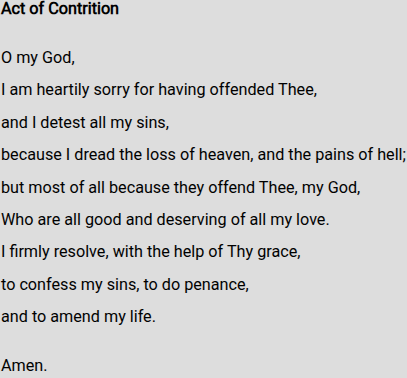
(Make An Act Of Contrition}
Views: 19