Sermon For The Third Sunday After Easter: On The Value Of Time
Written by AJ Baalman on April 25, 2026
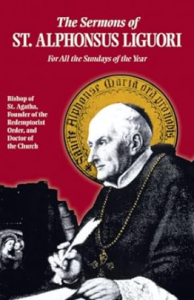
The Sermon Comes From This Book, Click Image To Get A Copy
Read First Sunday After Easter’s Sermon
Read Second Sunday After Easter’s Sermon
“A little while, and now you shall not see me.” JOHN xvi. 16.
THERE is nothing shorter than time, but there is nothing more valuable. There is nothing
shorter than time; because the past is no more, the future is uncertain, and the present is but a
moment. This is what Jesus Christ meant when he said: “A little while, and now you shall
not see me. ” We may say the same of our life, which, according to St. James is but a vapour,
which is soon scattered for ever. ”For what is your life? It is a vapour which appeareth for a
little while.” (James iv. 14.) But the time of this life is as precious as it is short; for, in every
moment, if we spend it well, we can acquire treasures of merits for heaven; but, if we employ
time badly, we may in each moment commit sin, and merit hell. I mean this day to show you
how precious is every moment of the time which God gives us, not to lose it, and much less
to commit sin, but to perform good works and to save our souls.
+
1. “Thus saith the Lord: In an acceptable time I have heard thee, and in the day of salvation I
have helped thee.” (Isa. xlix. 8.) St. Paul explains this passage, and says, that the acceptable
time is the time in which God has determined to confer his favours upon us. He then adds:
”Behold, now is the acceptable time; behold, now is the day of salvation.” (2 Cor. vi. 2.) The
Apostle exhorts us not to spend unprofitably the present time, which he calls the day of
salvation; because, perhaps, after this day of salvation, there shall be no salvation for us. “The
time,” says the same Apostle, “is short; it remaineth that .they that weep be as though they
wept not; that they that rejoice, as if they rejoiced not; and they that buy, as though they
possessed not; and they that use this world, as if they used it not.” (1 Cor. vii. 29, 30, 31.)
+
Since, then, the time which we have to remain on this earth is short, the Apostle tells those
who weep, that they ought not to weep, because their sorrows shall soon pass away; and
those who rejoice, not to fix their affections on their enjoyments, because they shall soon have
an end. Hence he concludes, that we should use this world, not to enjoy its transitory goods,
but to merit eternal life.
+
2. ”Son,” says the Holy Ghost, ”observe the time.” (Eccl. iv. 2 3.) Son, learn to preserve time,
which is the most precious and the greatest gift that God can bestow upon you. St.
Bernardino of Sienna teaches that time is of as much value as God; because in every moment
of time well spent the possession of God is merited. He adds that in every instant of this life a
man may obtain the pardon of his sins, the grace of God, and the glory of Paradise. “Modico
tempore potest homo lucrari gratiam et gloriam.” Hence St. Bonaventure says that “no loss
is of greater moment than the loss of time.” (Ser. xxxvii. in Sept.)
+
3. But, in another place, St. Bernardino says that, though there is nothing more precious than
time, there is nothing less valuable in the estimation of men. ”Nil pretiosius tempore, nil
vilius reputatur.” (Ser. ii. ad Schol.) You will see some persons spending four or five hours in
play. If you ask them why they lose so much time, they answer: To amuse ourselves. Others
remain half the day standing in the street, or looking out from a window. If you ask them
what they are doing, they shall say in reply, that they are passing the time. And why says the
same saint, do you lose this time? Why should you lose even a single hour, which the mercy
of God gives you to weep for your sins, and to acquire the divine grace? “Donec hora
pertranseat, quam tibi ad agendam pœnitentiam, ad acquirendam gratiam, miseratio
conditoris indulserit.”
+
4. O time, despised by men during life, how much shall you be desired at the hour of death,
and particularly in the other world! Time is a blessing which we enjoy only in this life; it is
not enjoyed in the next; it is not found in heaven nor in hell. In hell, the damned exclaim with
tears: “Oh! that an hour were given to us.” They would pay any price for an hour or for a
minute, in which they might repair their eternal ruin. But this hour or minute they never
shall have. In heaven there is no weeping; but, were the saints capable of sorrow, all their
wailing should arise from the thought of having lost in this life the time in which they could
have acquired greater glory, and from the conviction that this time shall never more be given
to them. A deceased Benedictine nun appeared in glory to a certain person, and said that she
was in heaven, and in the enjoyment of perfect happiness; but that, if she could desire
anything, it would be to return to life, and to suffer affliction, in order to merit an increase of
glory. And she added that, to acquire the glory which corresponded to a single Ave Maria,
she would be content to suffer till the day of judgment the long and painful sickness which
brought on her death. Hence, St. Francis Borgia was careful to employ every moment time for
God. When others spoke of useless things; he conversed with God by holy affections; and so
recollected was he that, when asked his opinion on the subject of conversation, he knew not
what answer to make. Being corrected for this, he said: I am content to be considered stupid,
rather than lose my time in vanities.
+
5. Some of you will say: What evil am I doing ? Is it not, I ask, an evil to spend your time in
plays, in conversations, and useless occupations, which are unprofitable to the soul? Does
God give you this time to lose it? “Let not,” says the Holy Ghost, ”the part of a good gift
overpass thee.” (Eccl. xiv. 14.) The work men of whom St. Matthew speaks did no evil; they
only lost time by remaining idle in the streets. But they were rebuked by the father of the
family, saying “Why stand you here all the day idle ?” (Matt. xx. 6.) On the day of judgment
Jesus Christ shall demand an account, not only of every month and day that has been lost,
but even of every idle word. ”Every idle word that men shall speak, they shall render an
account for it on the day of judgment.” (Matt. xii. 36.) He shall likewise demand an account of
every moment of the time which you shall lose. According to St. Bernard, all time which is
not spent for God is lost time. “Omne tempus quo de Deo non cogitasti, cogita te perdisse.”
(Coll. 1, cap. viii.) Hence the Holy Ghost says: “Whatsoever thy hand is able to do, do it
earnestly: for neither work nor reason. . . .shall be in hell, whither thou art hastening.” (Eccl.
ix. 10.) What you can do Today defer not till to-morrow; for on tomorrow you may be dead,
and may be gone into another world, where you shall have no more time to do good, and
where you shall only enjoy the reward of your virtues, or suffer the punishment due to your
sins. “Today if you shall hear his voice, harden not your hearts.” (Ps. xciv. 8.) God calls you
to confess your sins, to restore ill-gotten goods, to be reconciled with your enemies. Obey his
call to-day; for it may happen that on tomorrow time may be no more for you, or that God
will call you no more. All our salvation depends on corresponding with the divine calls, and
at the time that God calls us.
+
6. But some of you will perhaps say: I am young; after some time I will give myself to God.
But, remember that the gospel tells us, that Jesus Christ cursed the fig tree which he found
without fruit, although the season for figs had not yet arrived. “It was not the time for figs.”
(Mark xi. 13.) By this the Saviour wished to signify, that man at all times, even in youth,
should produce fruits of good works; and that otherwise, like the fig tree, he shall be cursed,
and shall produce no fruit for the future. “May no man here after eat any more fruit of thee
for ever.” (Ibid., v. 14.)”Delay not to be converted to the Lord, and defer it not from day to
day; for his wrath shall come on a sudden.” (Eccl. v. 8, 9.) If you find your soul in the state of
sin, delay not your repentance nor your confession; do not put them off even till to-morrow;
for, if you do not obey the voice of God calling you Today to confess your sins, death may
this day overtake you in sin, and tomorrow there may be no hope of salvation for you. The
devil regards the whole of our life as very short, and therefore he loses not a moment of time,
but tempts us day and night. ”The devil is come down unto you having great wrath, knowing
that he hath but a short time.” (Apoc. xii. 12.) The enemy, then, never loses time in seeking to
bring us to hell: and shall we squander the time which God has given us to save our souls?
+
7. You say: “I will hereafter give myself to God.” But “why” answers St. Bernard, “do you, a
miserable, sinner, presume on the future, as if the Father placed time in your power ?”
(Serm.xxxviii., de Part., etc.) Why do you presume that you will hereafter give yourself to God, as if
he had given to you the time and opportunity of returning to him whenever you wish? Job
said with trembling, that he knew not whether another moment of his life remained: “For I
know not how long I shall continue, and whether after a while my Maker may take me
away.” (xxxii. 22.) And you say: I will not go to confession to-day; I will think of it tomorrow.
“Diem tenes,” says St. Augustine, “qui horam non tenes.” How can you promise yourself
another day, when you know not whether you shall live another hour?”If,” says St. Teresa,
”you are not prepared to die today, tremble, lest you die an unhappy death.”
+
8. St. Bernardino weeps over the blindness of those negligent Christians who squander the
days of salvation, and never consider that a day once lost shall never return. “Transcunt dies,
salutis et nemo recogitat sibi perire diem ut nunquam rediturum.” (Serm. ad Scholar.) At the
hour of death they shall wish for another year, or for another day; but they shall not have it:
they shall then be told that “time shall be no more.” What price would they not then give for
another week, for a day, or even for an hour, to prepare the account which they must then
render to God? St. Lawrence Justinian says, that for a single hour they would give all their
property, all their honours, and all their delights. “Erogaret opes, honores delicias, pro una
horula.” (Vit. Solit., cap. x.) But this hour shall not be granted to them. The priest who attends
them shall say: Depart, depart immediately from this earth; for your time is no more. ”Go
forth, Christian soul, from this world.”
+
9. What will it profit the sinner who has led an irregular life, to exclaim at death:! that I had
led a life of sanctity! 0! that I had spent my years in loving God! How great is the anguish of a
traveller, who, when the night has fallen, perceives that he has missed the way, and that
there is no more time to correct his mistake! Such shall be the anguish at death of those who
have lived many years in the world, but have not spent them for God. “The night cometh
when no man can work.” (John ix. 4.) Hence the Redeemer says to all: “Walk whilst you have
light, that the darkness overtake you not.” (John xii. 35.) Walk in the way of salvation, now
that you have the light, before you are surprised by the darkness of death, in which you can
do nothing. You can then only weep over the time which you have lost.
+
10. “He hath called against me the time.” (Thren. i. 15.) At the hour of death, conscience will
remind us of all the time which we have had to become saints, and which we have employed
in multiplying our debts to God. It will remind us of all the calls and of all the graces which
he has given us to make us love him, and which we have abused. At that awful moment we
shall also see that the way of salvation is closed for ever. In the midst of these remorses, and
of the torturing darkness of death, the dying sinner shall say: O fool that I have been! life
misspent! lost years, in which I could have gained treasures of merits, and have become a
saint! but I have neglected both, and now the time of saving my soul is gone for ever. But of
what use shall these wailings and lamentations be, when the scene of this world is about to
close, the lamp is on the point of being extinguished, and when the dying Christian has
arrived at that great moment on which eternity depends?
+
11. ”Be you then also ready; for, at what hour you think not, the Son of Man will come.”
(Luke xii. 40.; The Lord says: ”Be prepared.” He does not tell us to prepare ourselves when
death approaches, but to be ready for his coming; because when we think least of death, the
Son of Man shall come and demand an account of our whole life. In the confusion of death, it
will be most difficult to adjust our accounts, so as to appear guiltless before the tribunal of
Jesus Christ. Perhaps death may not come upon us for twenty or thirty years; but it may also
come very soon, perhaps in a year or in a month. If any one had reason to fear that a trial
should take place, on which his life depended, he certainly would not wait for the day of the
trial, but would as soon as possible employ an advocate to plead his cause. And what do we
do? We know for certain that we must one day be judged, and that on the result of that
judgment our eternal, not our temporal, life depends. We also know that that day may be
very near at hand; and still we lose our time, and, instead of adjusting our accounts, we go on
daily multiplying the crimes which will merit for us the sentence of eternal death.
+
12. If, then, we have hitherto employed our time in offending God, let us henceforth
endeavour to bewail our misfortune for the remainder of our life, and say continually with
the penitent King Ezechias: ”I will recount to thee all my years in the bitterness of my soul.”
(Isn. xxxviii. 15.) The Lord gives us the remaining days of life, that we may compensate the
time that has been badly spent. “Whilst we have time, let us work good.” (Gal. vi. 10.) Let us
not provoke the Lord to punish us by an unhappy death; and if, during the years that are
passed, we have been foolish, and have offended him, let us now attend to the Apostle
exhorting us to be wise for the future, and to redeem the time we have lost. “See, therefore,
brethren, now you walk circumspectly, not as unwise, but as wise, redeeming the time,
because the days are evil,… understanding what is the will of God. ” (Eph. v. 15, 16, 17.) “The
days are evil.” According to St. Anselm, the meaning of these words is, that the days of this
life are evil, because in them we are exposed to a thousand temptations and dangers of
eternal misery; and therefore, to escape perdition, all possible care is necessary. “What,” says
St. Augustine, “is meant by redeeming the time, unless, when necessary, to submit to
temporal loss in order to gain eternal goods ?” (de Hom. 50, Hom, i.) We should live only to
fulfil with all diligence the divine will; and, should it be necessary, it is better to suffer in
temporal things, than to neglect our eternal interests. Oh! how well did St. Paul redeem the
time which he had lost! St. Jerome says, that though the last of the apostles, he was, on
account of his great labours, the first in merits. “Paul, the last in order, but the first in merits,
because he laboured more than all.” Let us consider that, in each moment, we may lay up
greater treasures of eternal goods. If the possession of all the land round which you could
walk, or of all the money which you could count in a day, were promised you, would you
lose time? or would you not instantly begin to walk over the ground, or to reckon the money?
You now have it in your power to acquire, in each moment, eternal treasures; and will you,
notwithstanding, misspend your time? Do not say, that what you can do Today you can also
do to-morrow; because this day shall be then lost to you, and shall never return. You have
this day; but perhaps tomorrow will not be given you.
+
Views: 72