On The Pain Of Loss That Those In Hell Suffer
Written by AJ Baalman on November 7, 2026
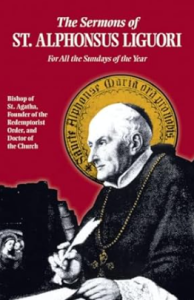
The Sermon Comes From This Book, Click Image To Get A Copy
” Cast him into the exterior darkness; there shall be weeping and gnashing of teeth.” MATT.
xxii. 13.
+
ACCORDING to all laws, divine and human, the punishment of crime should be
proportioned to its grievousness. “According to the measure of the sin shall the measure also
of the stripes be.” (Deut. xxv. 2.) Now, the principal injury which sinners do to God by mortal
sin, consists in turning their back upon their Creator and their sovereign good. St. Thomas
defines mortal sin to be”a turning away from the immutable good” (p. 1, qu. 24, art. 4). Of
this injury the Lord complains in the following words: ”Thou hast forsaken me, saith the
Lord; thou hast gone backward. ” (Jer. xv. 6.) Since, then, the greatest guilt of the sinner
consists in deliberately consenting to lose God, the loss of God shall constitute his greatest
punishment in hell. ”There shall be weeping.” In hell there is continual weeping; but what is
the object of the bitterest tears of the unhappy damned? It is the thought af having lost God
through their own fault. This shall be the subject of the present discourse. Be attentive,
brethren.
+
1. No! dearly beloved Christians! the goods of the earth are not the end for which God has
placed you in the world; the end for which he has created you is the attainment of eternal life.
”And the end life eternal.” (Rom. vi. 22.) Eternal life consists in loving God, and possessing
him for eternity. Whosoever attains this end shall be for ever happy; but he who, through his
own fault, does not attain it, loses God; he shall be miserable for eternity, and shall weep for
ever, saying: ”My end is perished.” (Lamen. iii. 18.)
+
2. The pain produced by loss is proportioned to the value of what has been lost. If a person
lose a jewel a diamond worth a hundred crowns, he feels great pain; if the diamond were
worth two hundred crowns, the pain is double; if worth four hundred, the pain is still
greater. Now, I ask, what is the good which a damned soul has lost? She has lost God; she has
lost an infinite good. The pain, then, arising from the loss of God is an infinite pain. ”The pain
of the damned,” says St. Thomas, ”is infinite, because it is the loss of an infinite good.” (1. 2,
qu. 87, a. 4.) Such, too, is the doctrine of St. Bernard, who says, that the value of the loss of the
damned is measured from the infinitude of God the supreme good. Hence, hell does not
consist in its devouring fire, nor in its intolerable stench, nor in the unceasing shrieks and
bowlings of the damned, nor in the terrific sight of the devils, nor in the narrowness of that
pit of torments, in which the damned are thrown one over the other: the pain which
constitutes hell is the loss of God. In comparison of this pain, all the other torments of hell are
trifling. The reward of God’s faithful servants in heaven is, as he said to Abraham, God
himself. ”I am thy reward, exceeding great.” (Gen. xv. 1.) Hence, as God is the reward of the
blessed in heaven, so the loss of God is the punishment of the damned in hell.
+
3. Hence, St. Bruno has truly said, that how great soever the torments which may be inflicted
on the damned, they never can equal the great pain of being deprived of God. Add torments
to torments, but do not deprive them of God. ”Addantur tormenta tormentis, et Deo non
priventur.” (Serm. de Jud. Fin.) According to St. Chrysostom, a thousand hells are not equal
to this pain. Speaking of the loss of God, he said: ”Si mille dixeris gehennas, nihil par dices
illius doloris.” (Hom, xlix., ad Pop.) God is so lovely that he deserves infinite love. He is so
amiable that the saints in heaven are so replenished with joy, and so absorbed in divine love,
that they desire nothing but to love God, and think only of loving him with all their strength.
At present, sinners, for the sake of their vile pleasures, shut their eyes, and neither know God
nor the love which he deserves; but in hell they shall, in punishment of their sins, be made to
know that God is an infinite good and infinitely amiable. ”The Lord shall be known when he
executeth judgment.” (Ps. ix. 17.) The sinner, drowned in sensual pleasures, scarcely knows
God: he sees him only in the dark, and therefore he disregards the loss of God. But in hell he
shall know God, and shall be tormented for ever by the thought of having voluntarily lost his
infinite good. A certain Parisian doctor appeared after death to his bishop, and said that he
was damned. His bishop asked him if he remembered the sciences in which he was so well
versed in this life. He answered, that in hell the damned think only of the pain of having lost
God.
+
4. ”Depart from me, ye cursed, into everlasting fire. ” (Matt. xxv. 41.) “Depart from me.” This
command constitutes the hell of the damned. Begone from me; you shall be no longer mine,
and I shall be no longer yours. ”You are not my people, and I will not be yours.” (Osee i. 9.)
At present this punishment is, as St. Augustine says, dreaded only by the saints. ”Hæc
amantibus non contemnentibus pœna est.” It is a punishment which affrights the soul that
loves God more than all the torments of hell; but it does not terrify sinners, who are
immersed in the darkness of sin. But at death they shall, for their greater chastisement,
understand the infinite good which they have lost through their own fault.
+
5. It is necessary to know that men have been created for God, and that nature draws them to
love him. In this life, the darkness of sin, and the earthly affections which reign in their
hearts, stifle their natural tendency and inclination to a union with God, their sovereign
good; and therefore the thought of being separated from him does not produce much pain.
But when the soul leaves the body, and is freed from the senses, which keeps her in darkness,
she then clearly sees that she has been created for God, and that he is the only good which
can make her happy. ”But,” says St. Antonine, ”the soul separated from the body
understands that God is her sovereign good, and that she has been created for him.” Hence,
as soon as she is loosed from the bondage of the body, she rushes forward to embrace her
supreme good: but because she is in sin, and his enemy, God will cast her off. Though driven
back and chased away, she retains her invincible tendency and inclination to a union with
God; and her hell shall consist in seeing herself always drawn to God, and always banished
from him.
+
6. If a dog see a hare, what effort does he not make to break his chain and seize his prey!
Thus, at her separation from the body, the natural inclinations of the soul draw her to God,
while at the same time sin separates her from him, and drags her with it into hell. Sin, says
the prophet, like a wall of immense thickness, is placed between the soul and God, and
separates her from him. ”But your iniquities have divided between you and your God.” (Isa. lix. 2.)
Hence, the unhappy soul, confined in the prison of hell, at a distance from God, shall
weep for ever, saying: Then, my God, I shall be no longer thine, and thou wilt be no longer
mine. I shall love thee no more, and thou will never again love me. This separation from God
terrified David, when he said: ”Will God, then, cast off for ever? or will he never be more
favourable again ?” (Ps. Ixxvi. 8.) How great, he says, would be my misery if God should cast
me from him, and never again be merciful to me! But this misery every damned soul in hell
suffers, and shall suffer for eternity. As long as he remained in sin, David felt his conscience
reproaching him, and asking, ”Where is thy God ?” David, where is thy God, who once loved
thee? Thou hast lost him; he is no longer thine. David was so afflicted at the loss of his God
that he wept night and day. ”My tears have been my bread day and night, whilst it has been
said to me daily: Where is thy God ?” (Ps. xli. 4.) Thus, even the devils will say to the
damned: Where is your God? By his tears David appeased and recovered his God; but the
damned shall shed an immense sea of tears, and shall never appease nor recover their God.
+
7. St. Augustine says, that if the damned saw the beauty of God, “they should feel no pain,
and hell itself would be converted into a Paradise.” (Lib. de Trip. Hab.) But the damned shall
never see God. When David forbade his son Absalom to appear in his presence, the sorrow of
Absalom was so great, that he entreated Joab to tell his father that he would rather be put to
death than never more be permitted to see his face. ”I beseech thee, therefore, that I may see
the face of the king; and if he be mindful of my iniquity, let him kill me.” (2 Kings xiv. <32.)
To a certain grandee, who acted irreverently in the church, Philip the Second said: ”Do not
dare ever to appear again in my presence.” So intense was the pain which the nobleman felt,
that after having returned home, he died of grief. What then must be the feelings of the
reprobate at the hour of death, when God shall say to them: Begone; let me never see you
again: you shall never more see my face!”I will hide my face from them; all evils and
afflictions shall find them.” (Deut. xxxi. 17.) What sentiments of pity should we feel at seeing
a son who was always united with his father, who always eat and slept with him, weeping
over a parent whom he loved so tenderly, and saying: My father, I have lost you; I shall
never see you more. Ah! if we saw a damned soul weeping bitterly, and asked her the cause
of her wailing, she would answer: I weep because I have lost God, and shall never see him
again.
+
8. The pain of the reprobate shall be increased by the knowledge of the glory which the saints
enjoy in Paradise, and from which they see, and shall for ever see, themselves excluded. How
great would be the pain which a person should feel if, after being invited by his sovereign to
his own theatre, to be present at the singing, dancing, and other amusements, he should be
excluded in punishment of some fault! How bitter should be his anger and disappointment
when, from without, he should hear the shouts of joy and applause within! At present
sinners despise heaven, and lose it for trifles, after Jesus Christ shed the last drop of his blood
to make them worthy of entering into that happy kingdom. But when they shall be confined
in hell, the knowledge of the glory of heaven shall be the greatest of all their torments. St.
John Chrysostom says, that to see themselves banished from that land of joy, shall be to the
damned a torment ten thousand times as great as the hell which they suffer. ”Decem mille
quis pœnat gehennas, nihil tale dicet quale est a beata gloria excidere.” (S. Joan. Chry. ap. 8.
Thorn. Suppl, qu. 98, art. 9.) Oh! that I had at least the hope, the damned will say, that after a
thousand, or even a million of ages, I could recover the divine grace, and become worthy of
entering into heaven, there to see God! But, no! he shall be told, ”When the wicked man is
dead, there shall be no hope any more. ” (Prov. xi. 7.) When he was in this life he could have
saved his soul; but because he has died in sin his loss is irreparable. Hence, with tears of
despair, he shall say: “I shall not see the Lord God in the land of the living.” (Isa. xxxviii. 11.)
+
9. The thought of having lost God and Paradise, solely through their own fault, shall increase
the torture of the damned. Every damned soul shall say: It was in my power to have led a life
of happiness on earth by loving God, and to have acquired boundless happiness for eternity;
but, in consequence of having loved my vices, I must remain in this place of torments as long
as God shall be God. She will then exclaim in the words of Job: “Who will grant me that I
might be according to the months past, according to the days in which God kept me ?” (Job
xxxix. 2.) Oh! that I were allowed to go back to the time I lived on earth, when God watched
over me, that I might not fall into this fire! I did not live among the savages, the Indians, or
the Chinese. I was not left without the sacraments, sermons, or masters to instruct me. I was
born in the bosom of the true Church, and have been well instructed and frequently
admonished by preachers and confessors. To this prison I have not been dragged by the
devils; I have come of my own accord. The chains by which I am bound and kept at a
distance from God, I have forged with my own will. How often has God spoken to my heart,
and said to me: Amend, and return to me. Beware, lest the time should come when thou shalt
not be able to prevent thy destruction. Alas! this time has come; the sentence has been
already passed; I am damned; and for my damnation there neither is, nor shall be, any
remedy for all eternity. But if the damned soul has lost God, and shall never see him, perhaps
she can at least love him?! No; she has been abandoned by grace, and thus she is made the
slave of her sins, and compelled to hate him. The damned see that God is their adversary on
account of their contempt for him during life, and are therefore always in despair. ”Why hast
thou set me opposite to thee, and I am become burthensome to myself.” (Job vii. 20.) Hence,
because the damned see that they are enemies of God, whom they at the same time know to
be worthy of infinite love, they are to themselves objects of the greatest horror. The greatest
of all the punishments which God shall inflict on them, will consist in seeing that God is so
amiable, and that they are so deformed, and the enemies of this God. “I will set before thy
face.” (Ps. xlix. 21.)
+
10. The sight of all that God has done for the damned shall above all increase their torture.
“The wicked shall see and shall be angry.” (Ps. cxi. 10.) They shall see all the benefits which
God bestowed upon them all the lights and calls which he gave them and the patience with
which he waited for them. They shall, above all, see how much Jesus Christ has loved them,
and how much he has suffered for the love of them; and after all his love and all his
sufferings, they shall see that they are now objects of his hatred, and shall be no longer
objects of his love. According to St. Chrysostom, a thousand hells are nothing compared with
the thought of being hateful to Christ. ”Si mille quis ponat, gehennas, nihil tale dicturus est,
quale est exosum esse Christo.” (Hom xiv. in Matt.) Then the damned shall say: My
Redeemer, who, through compassion for me, sweated blood, suffered an agony in the garden,
and died on the cross bereft of all consolation, has now no pity on me! I weep, I cry out; but
he no longer hears or looks to me! He is utterly forgetful of me. He once loved me; but now he
hates and justly hates me; for I have ungratefully refused to love him. David says, that the
reprobate are thrown into the pit of death. “Thou shalt bring them down into the pit of
destruction.” (Ps. liv. 24.) Hence St. Augustine has said: ”The pit shall be closed on top, it
shall be opened at the bottom, it shall be expanded downwards; and they who refuse to know
God shall be no longer known by him.”“Puteus claudetur sursum, aperietur deorsum,
dilatatibur in profundum: et ultra nescientur a Deo qui Deum scire noluerunt.” (Hom, xvi.,
cap 50.)
+
11. Thus the damned see that God deserves infinite love, and that they cannot love him. St.
Catherine of Genoa being one day assailed by the devil, asked him. who he was. He
answered with tears: I am that wicked one who is deprived of the love of God. I am that
miserable being that can never more love God. They not only cannot love God, but,
abandoned in their sins, they are forced to hate him: their hell consists in hating God, whom
they at the same time know to be infinitely amiable. They love him intensely as their
sovereign good, and hate him as the avenger of their sins. ”Res miserrima,” says a learned
author, ”amare vehementer, et amatum simul odisse.” (Magnotius Medit.) Their natural love
draws them continually to God; but their hatred drags them away from him. These two
contrary passions, like two ferocious wild beasts, incessantly tear in pieces the hearts of the
damned, and cause, and shall for all eternity cause, them to live in a continual death. The
reprobate then shall hate and curse all the benefits which God has bestowed upon them.
They shall hate the benefits of creation, redemption, and the sacraments. But they shall hate
in a particular manner the sacrament of baptism, by which they have, on account of their
sins, been made more guilty in the sight of God; the sacrament of penance, by which, if they
wished, they could have so easily saved their souls; and, above all, the most holy sacrament
of the altar, in which God had given himself entirely to them. They shall consequently hate
all the other means which have been helps to their salvation. Hence, they shall hate and curse
all the angels and saints. But they shall curse particularly their guardian angels their special
advocates and, above all, the divine mother Mary. They shall curse the three divine persons
the Father, the Son, and the Holy Ghost; but particularly Jesus Christ, the Incarnate Word,
who suffered so much, and died for their salvation. They shall curse the wounds of Jesus
Christ, the blood of Jesus Christ, and the death of Jesus Christ. Behold the end to which
accursed sin leads the souls which Jesus Christ has dearly bought.
+
Closing Advertisement: Support Ordo Militaris Catholicus!
Views: 4
Reader's opinions
You may also like

Continue reading